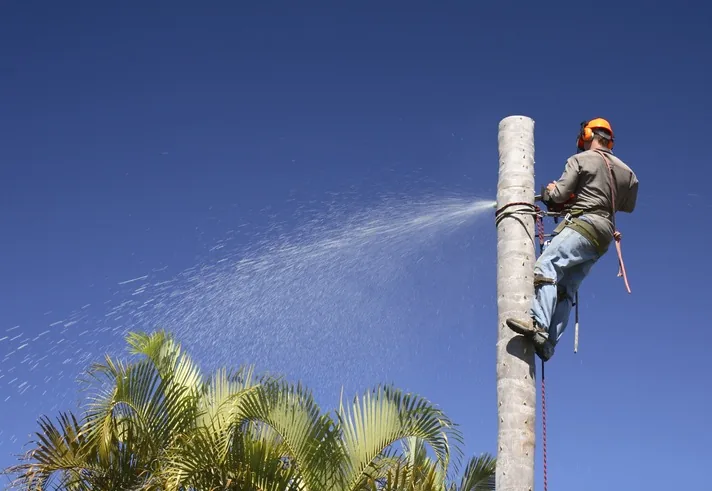
Coastal trees on sandy ground
Rockingham sits on the coast south of Perth, and nearly everything about tree work here comes back to sand and wind. Much of the area is built on pale coastal dune sands, the Quindalup and Safety Bay sands, with limestone underneath in places. The sea breeze arrives most summer afternoons, and winter fronts come straight in off the water.
Trees in this setting grow differently from those in the hills or on heavier soils. Roots spread wide through loose sand looking for moisture, canopies are shaped and sometimes burnt by the salt wind, and dead wood builds up on the sheltered side. A tree can look healthy from the street and still carry limbs that will not survive the first big blow of winter.
Housing and blocks
Rockingham has a wide spread of housing. Older areas near the foreshore and the original town centre sit alongside large estates built from the 1970s onward, and newer developments further from the coast. Toward the edges of the city there are also rural and special rural lots with remnant bush.
The mix matters because the job and the rules change with the lot:
- Older homes often have big trees planted decades ago, now crowding roofs, gutters and pergolas.
- Newer estates tend to have small lots, narrow side access and houses close to the fence, so sectional removal and hand-carrying are common.
- Rural and special rural lots can have large native trees and open space, which may allow felling, but different council rules apply (see below).
Trees we get called about in Rockingham
Tuart is the signature native tree of the southern coastal plain. Tuart woodlands and forests of the Swan Coastal Plain are listed as a critically endangered ecological community under federal environment law, which is one more reason to keep healthy tuarts where you can and prune rather than remove.
WA peppermint is everywhere, as a street tree and in backyards. It copes with coastal conditions but grows wide, drops leaf litter and suckers from the base.
Palms are common in Rockingham gardens, particularly Washingtonia and date palms. Dead fronds and heavy seed stalks drop onto driveways and roofs, and a tall palm beside the house is a job for someone with the right gear. See palm tree removal for how palms are cleaned or taken down.
You will also see Norfolk Island pines, Rottnest cypress and planted eucalypts, many of which have outgrown the blocks they were planted on.
Storms and the sea breeze
Rockingham gets its share of winter storms, and exposed coastal trees are often the first to lose limbs. The most useful thing you can do is have trees checked and deadwooded before winter, especially anything overhanging the house, the car or a play area.
If a tree or limb does come down, keep clear of it, and if it has brought down or is touching a power line, stay at least 8 metres away and call Western Power on 13 13 51. Our storm and emergency tree work page covers what to do next and how a fallen tree is made safe.
City of Rockingham rules
Residential lots
The City of Rockingham says there are no requirements in its Town Planning Scheme No. 2 for approval to remove a tree on residential properties. That covers most suburban blocks in Rockingham today.
Rural, Special Rural and Special Residential zones
Removing native trees on land zoned Rural, Special Rural or Special Residential needs the City's approval. Approval is generally limited to trees that are dead, diseased or dangerous, or where other laws require clearing. Clearing native vegetation can also need a state permit under the Environmental Protection Act 1986 unless an exemption applies. If your property is in one of these zones, talk to the City before any native tree comes down.
A possible change
From late March to April 2026 the City consulted the community on extending approval requirements to "significant trees" on all private lots. We have not seen an outcome, so we do not know whether the rules will change or when. Check the City's website before a large removal, even on a residential lot. Our guide, can I cut down a tree in Perth, explains the kinds of approval councils use.
Street trees
The City is responsible for planting, maintaining and removing street trees. If a verge tree is causing problems, report it to the City on 9528 0333 or through Rock Port.
Removal, lopping and stumps in sand
Where there is space, a tree may be felled in one piece or in a few large sections. On most suburban lots it is climbed and taken down in roped sections instead. Lopping, done properly, reduces a tree back to sound growth points so it stays but carries less weight into the wind.
Stumps in loose coastal sand generally grind well, but where limestone sits close to the surface the grinder can only go so deep. Long lateral roots often run under lawns and paving. Tell the arborist if you plan to build, pave or lay turf so the stump work can be quoted to suit.
Power lines and shot-hole borer
Power lines. Keeping trees on private property clear of power lines is the resident's job, and Western Power does not trim around the service wire from the pole to the house. A notice gives 40 days to have it cleared.
Shot-hole borer. The whole Perth metro area is inside the polyphagous shot-hole borer quarantine area. Check your address on DPIRD's zone map, as zones differ and the rules for moving wood and green waste depend on them.
What tree work costs in Rockingham
As a 2026 guide, a small tree in an open yard is often $400 to $1,000, a medium tree $1,000 to $2,500, and a large tree close to the house $2,500 to $6,000 or more. Most palm removals fall between $150 and $1,500. A single average stump usually grinds for $100 to $400. These are planning figures, not quotes. The tree removal cost guide explains what moves the price.
Arranging a quote
Call or use the form with a photo of the tree and a note about what is near it. We will arrange a local arborist to look at it and give you a written price. We ask the arborists and contractors we work with to hold the public liability cover the job needs; ask to see the certificate before work begins. We are open 7 days, 8am to 5pm.
Straight answers
Do I need approval to remove a tree on my Rockingham property?
On residential lots, the City of Rockingham says its Town Planning Scheme No. 2 has no requirement for approval to remove a tree. On Rural, Special Rural and Special Residential zoned land, removing native trees needs City approval, which is generally limited to dead, diseased or dangerous trees or where other laws require clearing. The City also consulted in 2026 on protecting significant trees on all private lots, so check the current position before booking.
Is the City of Rockingham changing its tree rules?
The City ran a community survey from late March to April 2026 on extending approval requirements to significant trees on all private lots. We have not seen an outcome, so we cannot say whether rules will change or when. The City's website is the place to check.
Who looks after the street tree on my Rockingham verge?
The City of Rockingham is responsible for planting, maintaining and removing street trees. Report problems to the City on 9528 0333 or through Rock Port rather than pruning or removing the tree yourself.
Why do coastal trees in Rockingham drop so many limbs?
Trees close to the coast deal with constant salt-laden wind, dry summers and sandy ground that holds little water, which leaves them with more dead wood and stressed limbs. Winter fronts then find the weak points. Regular deadwooding and reducing overlong limbs lowers the risk.
Free quote
Tell us about the tree
Send a few details and a photo if you have one, or call (08) 9560 6103. What happens next:
- A call back to talk through the tree and the access.
- A look on site, then a written price.
- A booked date, and a clean block when the crew leaves.