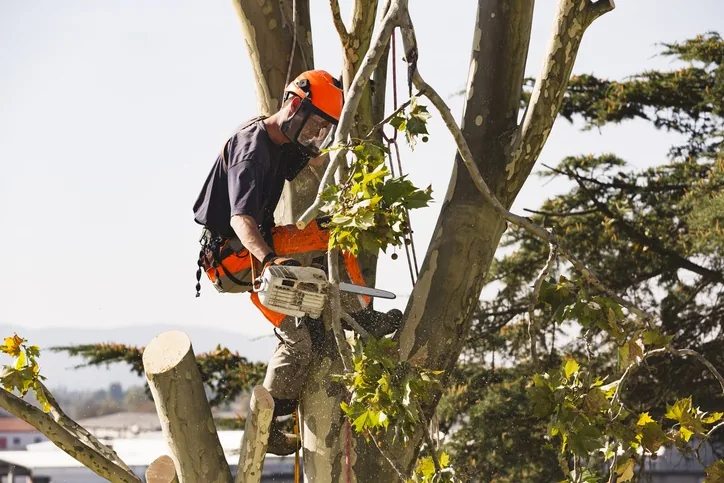
Tree work on the Cottesloe coast
Cottesloe is a small, coastal suburb where the trees work hard. Most gardens sit within a short walk of the ocean, so the salt-laden sea breeze that makes summer afternoons bearable also dries leaves, burns the windward side of canopies and slowly works away at older limbs. Under the sand, coastal limestone is often close to the surface. Put those two things together and you get trees that look settled from the street but carry more dead wood and stress than a similar tree further inland.
The jobs we are asked to arrange in Cottesloe reflect that. There is plenty of pruning: deadwood out of peppermints and figs, weight taken off limbs over roofs, clearance from gutters and driveways. There are also removals, often of trees planted decades ago that have grown too large for the block, or that have declined after years of wind and dry summers. On both, the arborist looks at the tree first and gives a written price after seeing the access.
Housing, blocks and access
A lot of Cottesloe's housing is older, with homes from the first half of the twentieth century sitting beside newer rebuilds. Blocks are often narrow, houses are built close to side boundaries, and gardens tend to be established, with limestone walls, paving, pools and mature planting that owners want protected.
That shapes how tree work is done here:
- Sectional climbing is the norm. There is rarely room to fell a large tree, so it is climbed and taken apart from the top, with heavier pieces lowered on ropes.
- Access is the price driver. A narrow side path, steps, or a garden with no clear route to the street means wood is carried out by hand or cut smaller, which takes longer.
- Walls and neighbours are close. Limestone walls, tiled roofs next door and boundary fences all need protecting while pieces come down.
- Verge space is shared. Chippers and trucks usually park on the street, so the crew needs somewhere to set up without blocking driveways.
If you know the access is tight, say so when you ask for a quote. Photos of the side gate and the path to the tree help the arborist plan.
Trees you see in Cottesloe gardens
The Norfolk Island pine is the tree most people link with Cottesloe, and many private gardens have them as well as the beachfront. They grow tall and straight, and removing one from a built-up street is always a sectional climb. WA peppermints are everywhere, weeping over fences and footpaths, and they grow wide for a small block. Tuart and coastal eucalypts, Moreton Bay figs in some older gardens, and Washingtonia palms round out the common list.
What they share here is exposure. On the coast the questions an arborist asks are often about wind: which limbs catch it, whether the canopy has become lopsided, whether dead wood has built up on the sheltered side, and whether the tree is sound enough to keep with pruning.
Pruning versus removal near the beach
Many Cottesloe trees can be kept with good pruning. Deadwooding, thinning the crown so wind moves through it, and reducing long limbs back to a sound fork all lower the load a tree carries into a winter storm. Tree pruning done this way is usually a better first step than taking a mature tree out, and it keeps the shade and screening that older gardens rely on.
Removal becomes the better answer when the tree is dead or dying, has a split main fork, is leaning in a way it did not used to, or is lifting walls and paving that cannot be fixed with root pruning. In those cases the tree removal is planned around the block: where the climber anchors, where pieces are lowered, and how the wood leaves the property. The stump can be left, ground out, or removed with the main roots if you are rebuilding. Limestone close to the surface can limit how deep a grinder goes, so ask the arborist what depth is realistic.
Town of Cottesloe rules
Street and verge trees
The Town of Cottesloe is responsible for removing street trees. Its Street Tree Policy, adopted in 2009 and reviewed in May 2022, states that unauthorised removal of a street tree is not permitted, and that unauthorised pruning may lead to prosecution. So even if a verge tree is dropping limbs on your car or blocking light, the answer is to contact the Town, not to cut it yourself or ask a contractor to.
One detail worth knowing: if you ask the Town to prune a street tree so more northern light reaches your house, the policy allows the Town to ask you to pay for the arborist advice and the pruning.
Trees on your own land
We have not found general tree-protection provisions for private gardens in the Town's planning scheme. That does not mean every tree can come out without a question. Heritage-listed places, trees covered by an earlier development approval and trees tied to a building project can all be treated differently. Check with the Town before a removal.
Some rules you may read about in the western suburbs apply to other councils, not Cottesloe, so rely on what the Town itself tells you. Our guide, can I cut down a tree in Perth, explains the kinds of approval that exist and what to ask.
Power lines, neighbours and green waste
Service wires. Many older Cottesloe homes still have an overhead service wire from the pole to the house. Keeping trees clear of it is the occupant's responsibility. Western Power issues a notice when vegetation is within 30 cm of the service wire, does not cut around it, and gives 40 days to have it cleared by a suitable arborist or tree lopper. Mention any wires in or near the canopy when you ask for a quote.
Neighbours. With houses close together, branches and roots often cross the boundary. In WA you can generally cut an overhanging branch back to your side of the boundary, but you cannot cut on the neighbour's side or enter their property without agreement. Talk to them first, and read our guide to neighbour tree disputes if it is not straightforward.
Shot-hole borer. The whole Perth metro area is inside the polyphagous shot-hole borer quarantine area, and there are rules about moving wood and green waste. Zones differ, so check your address on DPIRD's zone map rather than assuming. If you notice small holes, staining or sawdust-like frass on a tree, report it to DPIRD.
What tree work in Cottesloe costs
Prices are set on site, and in Cottesloe access often matters more than height. As a 2026 guide, a small tree in an open yard often sits around $400 to $1,000, a medium tree $1,000 to $2,500, and a large pine or gum close to the house $2,500 to $6,000 or more. A single average stump usually grinds for $100 to $400. Tight side access, lowering over walls and work near service wires all push toward the higher end. The tree removal cost guide explains the bands in more detail.
Getting a quote
Call or use the form with a photo of the tree, a note of what sits under it, and how the crew would get to it. We will arrange a local arborist to come out, look at it and put the price in writing. We ask the arborists and contractors we work with to hold the public liability cover the job needs, so ask to see the certificate before work starts. We are open 7 days, 8am to 5pm.
Straight answers
Can I prune the street tree outside my Cottesloe home?
No. The Town of Cottesloe is responsible for street trees, unauthorised removal is not permitted, and unauthorised pruning may lead to prosecution. Contact the Town with your request instead. If you ask for pruning to let in northern light, the Town may ask you to pay for the arborist advice and the pruning.
Do I need the Town's approval to remove a tree in my own Cottesloe garden?
We have not found a general approval requirement for private trees in Cottesloe's planning scheme, but that is not the same as saying none applies. Heritage places and trees protected by an earlier approval can be treated differently. Check with the Town of Cottesloe before booking a removal.
Why do trees near the Cottesloe coast need pruning more often?
Constant salt-laden wind burns and shapes the canopy, and shallow limestone limits how deep roots can go. That combination leaves more dead wood and more stressed limbs than a sheltered inland garden. Regular deadwooding and a light reduction are usually cheaper than dealing with a limb after a winter front.
Can a big tree be removed from a narrow Cottesloe block?
Usually, yes. On tight blocks the tree is climbed and taken down in small roped sections, lowered past walls and roofs rather than dropped. Access through a side gate or across the front yard decides what gear can be used, which is why the quote is given on site.
Free quote
Tell us about the tree
Send a few details and a photo if you have one, or call (08) 9560 6103. What happens next:
- A call back to talk through the tree and the access.
- A look on site, then a written price.
- A booked date, and a clean block when the crew leaves.