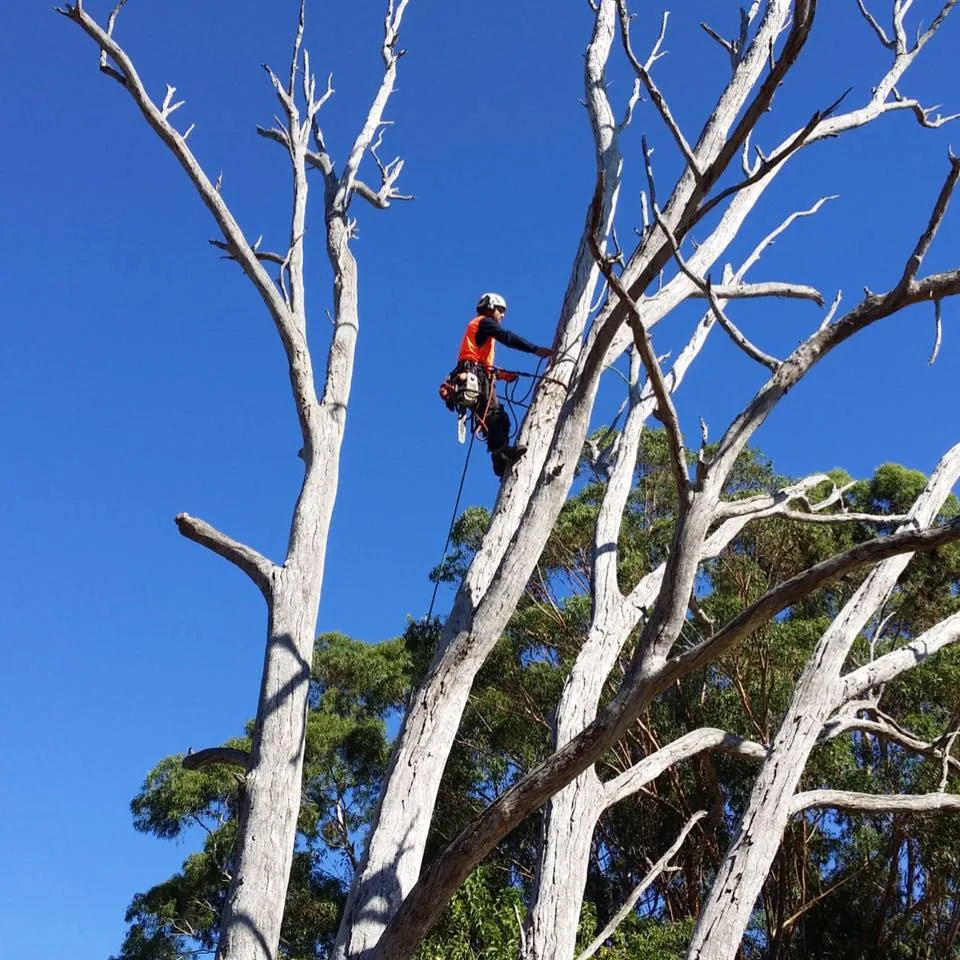
When removing the tree is the right call
Most trees are worth keeping. They shade the house through a Perth summer, hold sandy soil together and give birds somewhere to sit. But some trees reach a point where pruning will not fix the problem, and removal is the safer and more honest answer.
The usual reasons people ask us about removal:
- The tree is dead or dying. Dead eucalypts dry out and become brittle quickly in our summers, and dead wood gets harder and more dangerous to climb the longer it stands.
- It is leaning or has moved. A lean the tree has always had is often fine. A lean that is new, with cracked or lifted soil on one side of the trunk, is not.
- The trunk or a main fork has split. Included bark in a tight V-shaped fork is a common failure point in gums and some exotics.
- It is in the wrong place. Too close to the house, lifting paving or the slab, cracking a retaining wall, or standing where a pool, granny flat or driveway is going.
- It keeps dropping limbs. Some trees, particularly certain gums, shed branches over roofs, cars and play areas year after year.
- Pest or disease damage. Decay at the base, fungal brackets on the trunk, or signs of borer activity. See our shot-hole borer guide if you suspect it.
If you are unsure, ask the arborist to tell you whether the tree can be kept with pruning or a reduction. A good one will say so.
How a tree comes down on a Perth block
Very few suburban removals are a single cut at the base. Perth blocks keep getting smaller and houses sit closer to boundaries, so most trees are taken apart from the top down.
The on-site look
Before any price is given, the arborist checks the species and condition of the tree, how far it is from buildings, fences, pools and wires, and how gear and wood will get in and out. Narrow side gates, steep driveways, septic tanks and reticulation lines all change how the job is done. This is also when to point out anything you want protected, such as a new lawn or a favourite shrub.
Sectional removal
Where there is no room to drop the tree, a climber works up it, removing branches first and then the trunk in short lengths. Heavier pieces are tied off and lowered on ropes through a friction device at the base, so they come down under control instead of landing on the roof or fence. On bigger jobs an elevated work platform or crane may be used if the access allows it.
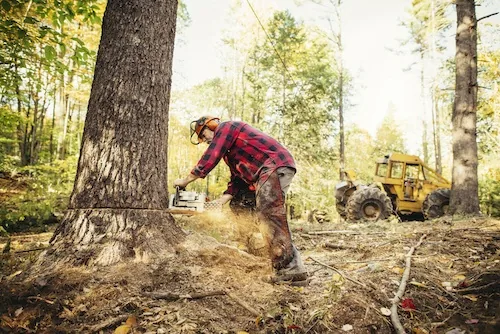
Felling
If there is open ground in the direction the tree needs to fall, such as a large backyard or a rural-residential block, it may be felled in one piece or in a few large sections. This is quicker and usually cheaper, but it needs clear space longer than the tree is tall.
Clean-up
Branches go through a chipper on site. Logs are cut to a size that can be carried out, or cut into firewood lengths if you want to keep them. The ground is raked and paths blown clear. If you want the mulch for your garden beds, say so when you book and it can be left in a pile.
Removing trees across different parts of Perth
The same species can be a very different job depending on which part of Perth it is growing in. Soil, block size and the age of the suburb all affect how a removal is planned. The suburb pages listed below go into more detail for particular areas.
Northern coastal suburbs
From the older parts of Joondalup to the newer estates around Wanneroo, trees grow in deep, pale sand. Roots run wide and shallow, so a mature gum can have roots well out past its canopy and under nearby paving. Newer estates tend to have small lots, narrow side access and houses close to the fence, which means more sectional climbing and more carrying by hand. Remnant tuart, banksia and marri are common, along with planted eucalypts that have outgrown the backyard.
Southern coastal suburbs
Around Spearwood, Hamilton Hill and down to Rockingham, yellow sand sits over limestone, and roots often work their way into cracks in the rock. Stumps in this ground can be awkward to grind because the grinder meets limestone close to the surface. Tuart, peppermint and Norfolk Island pine are common here, and older blocks often have large trees planted decades ago that now crowd the house.
Western suburbs and the coast
In Cottesloe, Mosman Park, Peppermint Grove and nearby, limestone is often very close to the surface and blocks can be on slopes. Tall Norfolk Island pines and big WA peppermints are typical, and many homes are older with established gardens, stone walls and limited access. Removals here are often sectional climbs with careful lowering to protect walls, roofs and neighbours' properties. Some of these areas have heritage places, so check with the council before any tree comes out.
Eastern suburbs and the hills
Suburbs on the eastern side of the river, such as Bayswater and Morley, sit on grey sand with a mix of older street trees and backyard gums. Further east, around Kalamunda and the hills, the ground turns to gravelly laterite and clay over granite. Trees on slopes are harder to rig, logs have to be lowered or winched rather than rolled, and access for a chipper or stump grinder can be the deciding factor in the price. Big marri and jarrah are common, and some blocks need extra thought about bushfire clearance around the house.
The stump: leave it, grind it or take it out
A standard removal leaves the stump cut low to the ground. After that you have three choices.
- Leave it. Fine in a garden bed or at the back of the block, though some species will resprout from the stump and need follow-up.
- Grind it. A stump grinder chews the stump down below ground level so you can lay turf, replant or put down mulch. The grindings can be left to fill the hole or taken away.
- Remove stump and roots. Needed when you are building, laying a slab or putting in a pool. This is a bigger job and usually quoted on its own.
Make sure the quote says which one you are getting, and to what depth if the stump is being ground.
What tree removal costs in Perth
Every removal is priced on site because access and what is underneath the tree change the price more than height alone. As a 2026 guide:
| Tree | Typical situation | Guide price (AUD) |
|---|---|---|
| Small | Open backyard, easy access | $400 to $1,000 |
| Medium | Some climbing, near a fence or shed | $1,000 to $2,500 |
| Large | Big gum or pine close to the house | $2,500 to $6,000 or more |
These are planning figures, not quotes. Stump grinding, restricted access, work near the power line to the house and removing the logs all affect the final number. The tree removal cost guide breaks this down further and explains how to compare quotes fairly.
Check these before you book
Council approval. Rules differ by council and are changing. The City of Cockburn now requires development approval to remove most mature trees over 8 metres on private land, and elsewhere trees on heritage places, on a significant tree register or protected by a development approval can need approval. Verge trees are the council's. Read can I cut down a tree in Perth and check with your council if in doubt.
Power lines. Trees near the power line to the house need someone authorised to work near live lines. Mention any wires in or near the canopy when you ask for a quote.
Neighbours. If the tree is on the boundary or belongs next door, sort it out with the neighbour before anyone cuts. Our guide to neighbour tree disputes covers the usual situations.
Cover. We ask the arborists and contractors we work with to hold the public liability cover the job needs. Ask to see the certificate before work starts.
When you are ready, call or use the form with a photo of the tree and a note about what is near it, and we will arrange for a local arborist to come and quote. The business holds a 5.0 rating from 23 Google reviews, and we are open 7 days, 8am to 5pm.