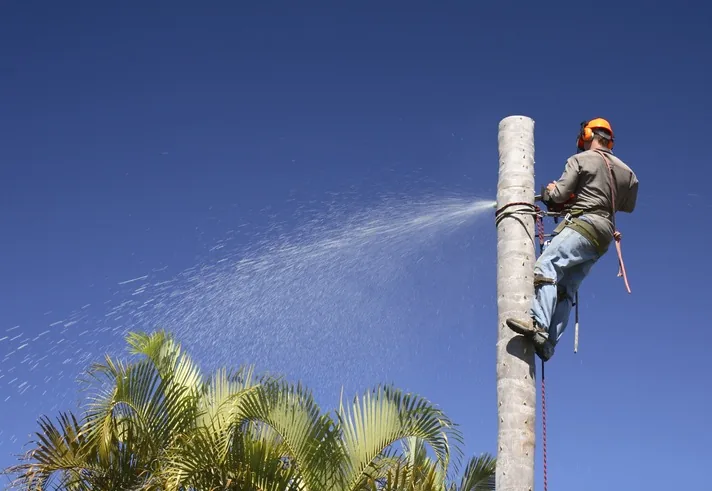
Palms in Perth gardens
Plenty of Perth palms are now much taller and heavier than whoever planted them expected. They suit the climate, so they grow well, and a palm that was knee-high by the pool can end up towering over the roofline.
Palms are also different from other trees to work on. They have no branches to tie off to, the trunk is fibrous rather than woody, the fronds and seed stalks are big and awkward, and some species are armed with spines. A palm job is planned differently from a gum or a pine.
The palms we get asked about most
Washingtonia (Mexican fan palm). The tall, thin fan palm seen along streets and in older backyards across Perth. It grows fast and can get very tall, with a small crown on top of a long trunk. Left alone, dead fronds hang down in a dense skirt that can shelter rats and holds a lot of dry, flammable material. The frond stalks have sharp, hooked teeth along the edges.
Canary Island date palm. The big, heavy palm with a thick trunk patterned by old frond bases and a wide crown of arching fronds. It is one of the heaviest palms to remove, and each frond has long, sharp spines near its base. Large orange seed clusters hang below the crown.
Cocos (queen) palm. Common around pools and courtyards. Lighter and easier to handle than a date palm, but it drops heavy bunches of orange fruit that stain paving and attract birds and pests. Dead fronds hang on until they are cut or fall.
Bangalow palm. A smooth-trunked palm with a green crownshaft at the top. It sheds whole fronds and large boat-shaped sheaths on its own, which can be heavy enough to damage roofs, gutters and cars when they come down.
Palm cleaning or full removal
Not every palm needs to come down. The choice usually comes down to whether the palm suits where it is.
A palm clean removes the dead and dying fronds, the old frond bases where needed, the flower stalks and seed pods, and any skirt of dead material hanging down the trunk. It leaves the green crown in place and makes the palm safer and tidier. It is the usual choice for a healthy palm that you want to keep.
Full removal makes sense when:
- the palm has outgrown the space and the crown is over the roof, a pool or the neighbour's yard
- falling fronds, sheaths or seed stalks keep landing on paths, cars or play areas
- the palm is too close to the house, a pool shell, a wall or pipes
- it sits under or near the overhead line to the house
- it is dead, badly damaged or has lost most of its crown
A clean is always cheaper than a removal on the day, but it has to be repeated as the palm keeps growing and shedding. If you are paying for a clean every year or two on a palm you do not really want, removal may work out better over time.
How a tall palm is removed
Very few palms in a Perth backyard can be dropped in one piece. There is rarely the room, and a palm trunk is heavy enough to smash paving, fences and pipes when it lands.
For most palms the job runs like this:
- The crown comes off first. The climber goes up the trunk, or works from an elevated platform where access allows, and removes the fronds and seed stalks, lowering or dropping them into a clear area.
- The top is cut off. The head of the palm, where the growing point sits, is cut free and lowered on a rope.
- The trunk is taken down in sections. Each length is cut and lowered, or dropped where there is a safe landing zone. Sections are kept to a weight that can be handled and carried out.
- The material leaves the block. Fronds are chipped or loaded out, trunk sections are carried or wheeled to the truck, and the area is raked clean.
Canary Island date palms get extra care. The spines at the frond bases are sharp enough to injure, and the trunk sections are very heavy. Washingtonias can be tall enough that climbing and lowering the crown is most of the job.
Heavy trunks and access
Palm trunks hold a lot of water, so they are heavier than they look. That weight is what drives most of the cost of a palm job.
When you ask for a quote, think about how the trunk sections will get from the palm to the street:
- Is there a side gate, and how wide is it?
- Are there steps, a slope or retaining walls on the way?
- Is the palm surrounded by paving, a pool, a pergola or a fence that sections must not land on?
- Can a truck park close to the property, or is there a long carry?
Where sections cannot be wheeled out, they may need to be cut smaller, which takes more time. Where there is open access, a bigger machine can lift them straight onto the truck.
Palm stumps and root balls
Palms do not have a spreading woody root system like a eucalypt. Instead, they grow a dense ball of thin, fibrous roots directly under the trunk. That changes what happens to the stump.
Grinding. A palm stump can be ground below ground level like any other. The fibrous material grinds differently from hardwood and can wrap around the grinder, but it is usually fine for a lawn or garden bed. See stump grinding for how that works.
Digging out the root ball. Because the roots are compact, the whole root ball can often be dug out with a small machine. This is the better choice if you are paving, building or replanting in the same spot.
Cutting flush and leaving it. The stump of a single-trunk palm will not reshoot, so leaving it cut at ground level is an option in garden beds. It softens and breaks down over time.
Clumping palms that grow from several stems at the base can keep producing new shoots, so those are best dug out if you want them gone.
2026 palm removal price guide
These are planning bands for 2026, in AUD. They are a guide only, and the final price comes from an on-site quote.
| Palm job | 2026 guide |
|---|---|
| Short, light palm (such as a small cocos) in an open yard | From about $150 |
| Most palm removals | $150 to $1,500 |
| Tall or heavy palm (such as a large Canary Island date) beside the house | Toward $1,500 |
| Stump grinding afterwards | Priced as a stump, from under $100 to $400 for most |
Height, trunk weight, the species, access for carrying out sections and the amount of material to dispose of are the main factors. A clean of dead fronds and seed pods is priced on site and costs less than removing the same palm. The tree removal cost guide sets palm prices next to tree removal and stump bands.
Before you book
Palms can be on a council significant tree list or covered by conditions on a heritage property, like any other tree. Check our guide to cutting down a tree in Perth if you are unsure. Mention any overhead wires near the crown, because work close to power lines needs the right people.
Send a photo of the whole palm, a photo of the access from the street, and a note on whether you want it cleaned or removed. The arborist will look at it on site and put the method, the stump and the clean-up on a written quote.